
One of the most loved professional basketball teams in the Philippines is Barangay Ginebra San Miguel. Its name is not a place but the brand of gin its parent company makes. In the Philippine Basketball Association (PBA), the team itself works as a moving billboard advertising the company's products. Using public information, this piece looks at how Ginebra has turned fan passion into gin sales.
1. A league of company teams with no home cities
Founded in 1975, the PBA was Asia's first professional basketball league and is regarded as the second-oldest professional basketball league in the world after the NBA. Its defining feature is that every team has been owned by a company since its founding, and none has a home city. Team names are built from company or product names and sometimes change to match the parent company's advertising strategy.
Ginebra is a textbook example. When it joined in 1979 as the team of distiller La Tondeña, it was called “Gilbey's Gin,” and its name kept changing as the product it promoted switched among whisky, rum and gin. Since 2012 it has played as Barangay Ginebra San Miguel and is owned by Ginebra San Miguel Inc. (GSMI), part of San Miguel Corporation (SMC), one of the country's largest conglomerates. SMC chairman Ramon S. Ang revealed in 2023 that the group spends about 1 billion pesos a year on its three PBA teams.
2. 'Never Say Die': A story of never giving up became the brand
Ginebra's signature is its “Never Say Die” spirit. Its origin goes back to a game on October 22, 1985. Playing coach Robert Jaworski was injured by an opponent's elbow, had his wound stitched at the hospital, then returned in the third quarter to lead the team to a comeback win. That dramatic game turned the team's habit of fighting back from behind into a story that captured fans' hearts.
For the team's 40th anniversary in 2019, the words “Never-Say-Die” appeared on its jerseys for the first time. The spirit is also put to work in advertising. GSMI's TV ad “One Ginebra Nation” was named one of the top three of about 200 ads at Kantar's first Creative Effectiveness Awards Philippines. A version themed on the Filipino never-say-die spirit has been viewed more than 10 million times.
3. What 'barangay' says about closeness to fans
The “Barangay” in the team's name is the smallest unit of local government in the Philippines, meaning a village or community. The name casts fans as residents of the village, members of one community, and Philstar has noted that in marketing terms it also served as a word for gin's typical consumers.
The size of the fan base shows in the numbers. In a 2008 Social Weather Stations (SWS) survey, Ginebra was the most popular PBA team nationwide with 31% support (tied with Purefoods) and drew 50% support in Metro Manila. Game 7 of the finals at the Philippine Arena on January 15, 2023, drew 54,589 people, the highest attendance in PBA history. The previous record, 54,086, was also set at a Ginebra game in 2017.
4. Gin seals for merch: Promotions that tie buying to the team
A distinctive part of Ginebra's marketing is promotions that link gin purchases directly to team merchandise. In 2016 it ran a campaign offering player figures in exchange for five gin seals and 150 pesos. In a 2018 limited-edition jersey campaign, fans could choose from five player designs by handing over six seals or four bottle caps plus 100 pesos. The 40th-anniversary jerseys were likewise given out in exchange for seals or caps.
For fans, buying gin becomes a way to support the team, and for the brand, the team's popularity turns directly into sales volume. The results of this cycle show in the company's performance. GSMI's 2025 revenue rose 8% year on year to 67.4 billion pesos and net income rose 20% to 8.7 billion pesos, while sales volume hit a record 51 million cases, the 12th straight year of growth. The company is described as the world's largest gin maker by volume.
5. Winning is marketing too
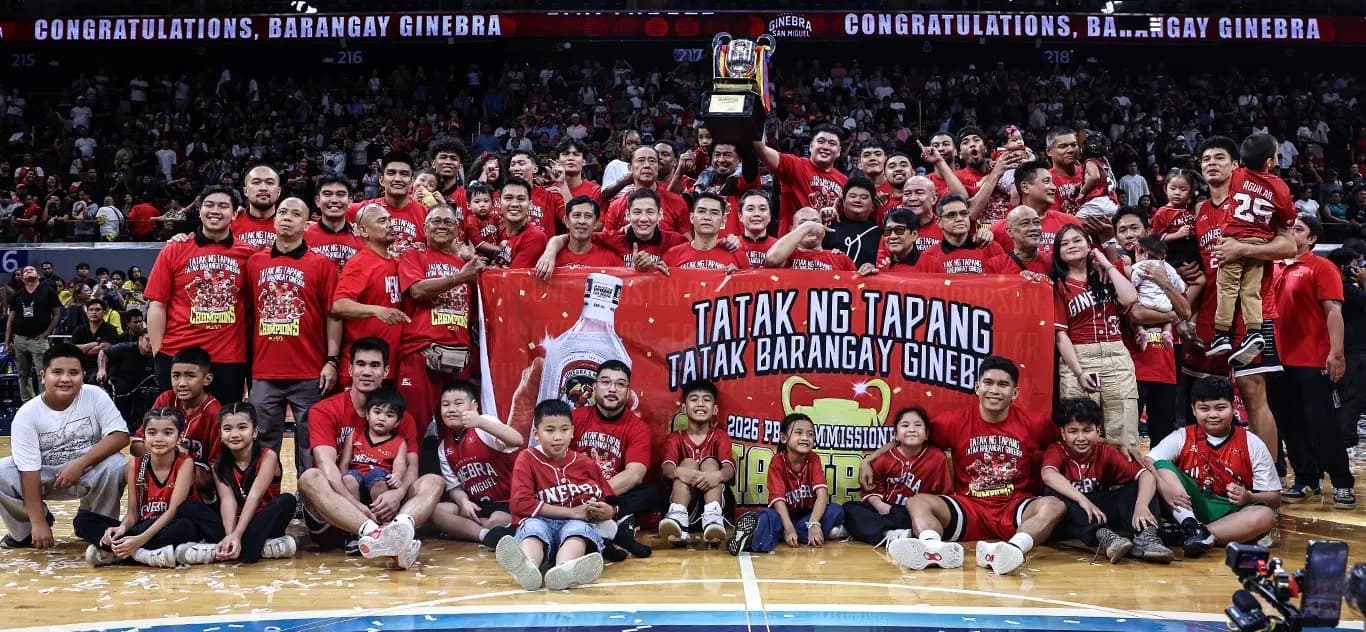
The team's strength also supports its brand value. Under celebrated coach Tim Cone, who took over in 2015, Ginebra has won eight titles, bringing Cone's career PBA championships to 26. At the 2026 Commissioner's Cup, Ginebra won Game 7 before a crowd of 24,617 at the Mall of Asia Arena in Manila, claiming the team's 16th title overall.
6. What it means for Japanese companies
Ginebra is a model of running a sports team not as a sponsorship property but as the brand itself. By overlaying the team's story on the brand's values and building product purchases into fan activity, cheering and consumption have become one. When Japanese companies use sports in the Philippines, going beyond logo placement to promotions fans can take part in and to storytelling makes it easier to turn the country's passion for sports into sales.