
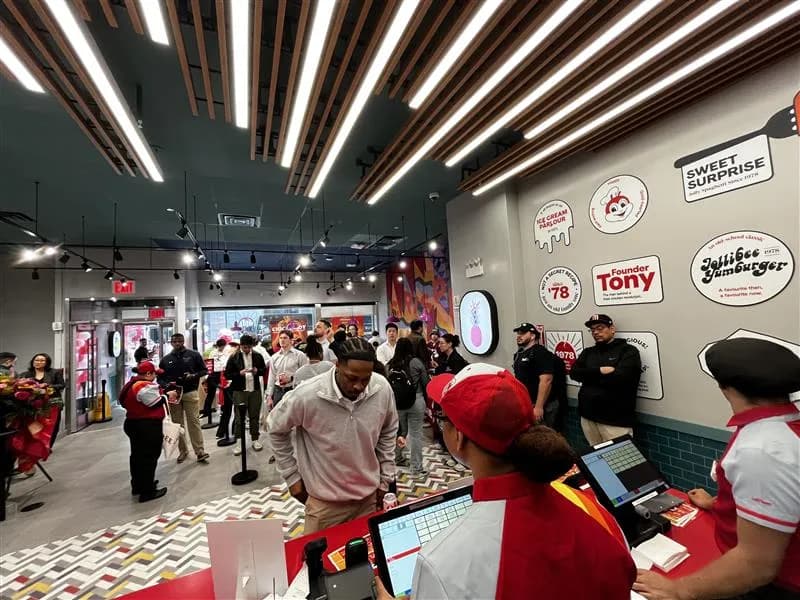
Philippine fast-food chain Jollibee is known for the long lines that form the night before it opens a new store abroad. Those at the front are often Filipinos living in that country. Its operator, Jollibee Foods Corporation (JFC), now runs more than 10,000 stores in 33 countries, and about two-thirds of its stores are overseas. Using public data, this piece looks at the marketing strategy that took the company worldwide using Filipino communities abroad as a foothold.
1. Two-thirds of stores overseas
According to JFC, its store count at the end of 2025 rose 5.9% year on year to 10,341, of which 3,504 were in the Philippines and 6,837 overseas. Overseas stores already make up about 66% of the total. Revenue in 2025 rose 12.6% to US$5.31 billion, and the international business accounted for 44% of system-wide sales (including franchises). Overseas also led on growth: in 2025, system-wide sales rose 27.0% abroad and 9.6% at home. By the end of the second quarter of 2026, the store count had grown to 10,767.
2. The core of the strategy: Start where Filipinos are
JFC's overseas strategy is clear. In 2018, then-CEO Ernesto Tanmantiong described a policy of opening stores where Filipino communities are large and expanding from there into the local mainstream market. Its first US store opened in 1998 in Daly City, California.
For Filipinos living abroad, Jollibee is the taste of home, a brand tied to family memories. A new store opening spreads on Filipinos' social media as news that a familiar taste has arrived, reliably generating early sales and buzz. The resulting lines then become advertising that catches the attention of local people.
3. When the line becomes the ad
Scenes from openings in different cities bear out this strategy. At the first London store in October 2018, the line stretched four blocks, most of it made up of Filipinos, the Inquirer reported. Some people lined up about 17 hours before opening. At the Manhattan store in New York that same month, the company drew a line by offering the first 40 customers a year's supply of free Chickenjoy fried chicken.
At the first Madrid store in Spain in September 2021, a line formed from 10 p.m. the night before, with Spanish customers joining Filipinos, GMA News reported. At the time, the company set out a plan to open 50 stores in Europe over five years and invest 50 million euros.
4. From fellow Filipinos to the local mainstream
The aim is to use the support of fellow Filipinos as a springboard to reach a wider local customer base. In 2018, JFC said that customers at the Manhattan store included many mainstream Americans as well as Filipinos. CEO Tanmantiong said roughly half the customers at opening were mainstream Americans.
Recognition from the mainstream media followed. In 2022, US food outlet Eater named Chickenjoy the best fast-food fried chicken in America, ahead of 15 chains including Popeyes and KFC. In July 2026, it also ranked first in the fast-food fried chicken category of USA TODAY's 10Best readers' poll for the third year in a row. According to Philstar, the company now has more than 100 stores in the United States and Canada, with average sales per store of US$4.9 million.
5. Broadening the brand portfolio through acquisitions
JFC has also raised its presence abroad by acquiring brands other than Jollibee. By 2018 it had invested a total of US$210 million to make US burger chain Smashburger a wholly owned subsidiary, and in 2019 it bought US coffee chain The Coffee Bean & Tea Leaf for US$350 million. In 2024 it took full ownership of Hong Kong dim sum chain Tim Ho Wan and acquired a 70% stake in Korean coffee chain Compose Coffee for US$238 million. It now has 19 brands in all.
In 2018 the company set a goal of becoming one of the world's top five restaurant companies. In brand valuation firm Brand Finance's 2026 restaurant brand ranking, Jollibee was rated fifth in the world for brand strength.
6. What it means for Japanese companies
Jollibee's case shows the effectiveness of making fellow nationals living in a country the first customers of an overseas expansion. A group certain to visit creates early sales and buzz, and lines and social media sharing extend reach to the local mainstream. Japanese companies can readily apply a similar phased approach: use Japanese residents abroad, Asian communities or fans of Japanese culture as the first foothold, and expand into the local market from there. For companies entering the Philippine market, meanwhile, the worldwide network of Filipinos can itself become a channel for word of mouth across borders.
Sources
Insider PH, Winning: Jollibee tops $5B revenue as global push pays off
Skift Table, Filipino fried chicken giant Jollibee focuses on U.S. growth
QSR Magazine, Jollibee opening first Manhattan location near Times Square
Jollibee Foods Corporation, Jollibee Foods Corporation announces accelerated U.S. expansion
Local 12, Jollibee's Chickenjoy named best fried chicken in America
FOX LA, Jollibee best fast-food fried chicken, USA TODAY 10Best
QSR Magazine, Jollibee acquires Coffee Bean & Tea Leaf for $350M
Inside Retail Asia, Jollibee Foods takes full ownership of Tim Ho Wan
MCA Insight, Jollibee aims to be in top 5 restaurant groups by 2025