
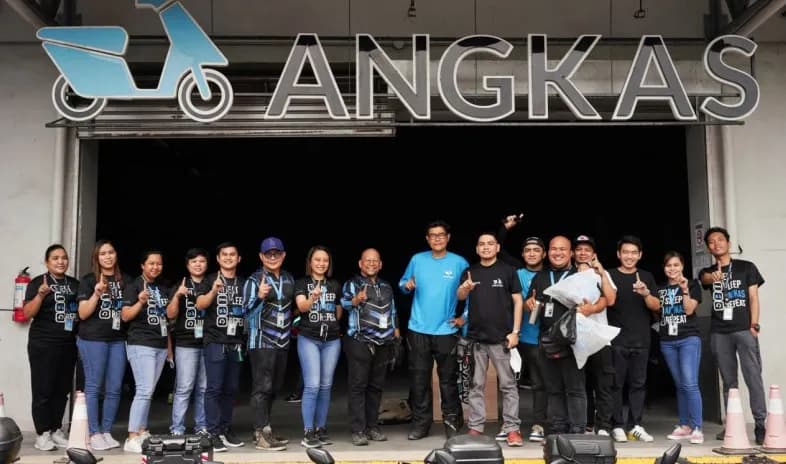
In Metro Manila's heavy traffic, motorcycle taxis are a fast way to get around. Angkas, the best-known motorcycle taxi app in the Philippines, is famous not only for its rides but also for its social media posts, which read more like a funny friend than a transport company. Using public information, this piece examines how Angkas built that voice.
1. A startup that grew up fighting regulators
Angkas was founded in 2016 by Angeline Tham and George Royeca, who became CEO in November 2021. Its name means "to ride pillion" in Filipino. Motorcycle taxis were not covered by national transport rules, and in November 2017 the Land Transportation Franchising and Regulatory Board (LTFRB) suspended Angkas for operating without a permit.
After court battles, the Department of Transportation (DOTr) approved a pilot program in June 2019 that allowed Angkas to operate in Metro Manila and Metro Cebu, later joined by JoyRide and Move It. Congress has debated a motorcycle taxi law for years, but as of 2026 none has passed, and the industry operates under department orders and LTFRB rules, including caps on the number of riders.
2. A brand voice born from "happy accidents"
Angkas' voice took shape around its 2018 comeback. According to a book on Philippine marketing, head of marketing Walter Wong called the brand identity a "series of happy accidents" that began when the social media manager posted a meme about the horror character Pennywise. The team targeted millennials and grew engagement organically, without paid boosts.
The team describes the brand as a "gago (foolish) but reliable friend." Posts are not approved from the top down; government relations and crisis teams only advise. "The worst thing you could do is just try to imitate without fundamentally knowing the principles behind it," Wong said.
3. Turning promos and trends into viral content
Angkas often packages discounts as jokes. In March 2022, when pandemic-era plastic barriers between rider and passenger were removed, it posted "RIP Angkas barrier (2021-2022, hopefully PLEASE LANG)" with a promo code, YEET. For Halloween in October 2022, it staged a "Horror Trip" with riders carrying folklore monsters such as the manananggal, with themed promo codes. "If mythological creatures can trust our services, so can you!" Royeca said.
The approach still works. In March 2026, an Angkas Facebook meme reacting to a viral scam story drew about 115,000 reactions and 11,000 shares.
4. Humor balanced with a safety message
Because motorcycle taxis raise safety concerns, Angkas pairs its jokes with a serious message about rider training. It offers free training and developed a basic motorcycle driving curriculum with the Technical Education and Skills Development Authority (TESDA). "We trained 200,000 motorcycle riders for free," Royeca said. The company's website claims a 99.997% safety record. In 2024, it signed an agreement with the Social Security System to cover 30,000 riders.
The voice has limits. In July 2019, a tweet comparing Angkas to sex drew criticism, including from the police, and the company deleted it and apologized, saying "we've missed the mark."
5. Expanding the brand
Angkas now offers parcel delivery and, since October 2024, a car service called Angcars, launched with typically self-deprecating copy: it said it aimed to be the "second best" in the market. In September 2024, it hired former foodpanda Philippines marketing head Dani Eleazar to lead consumer and brand development. "While Angkas has always been top-notch in being relatable, I'm excited to bring us closer to the consumers," she said.
6. What it means for Japanese companies
Angkas shows how far a consistent, human brand voice can go in the Philippines, one of the world's most active social media markets. For Japanese companies, the lessons are to give local social media teams real freedom, to use Filipino humor and Taglish naturally rather than translating Japanese copy, and to tie promotions to what people are already talking about. At the same time, clear limits are needed, especially for brands in regulated or safety-sensitive industries.