
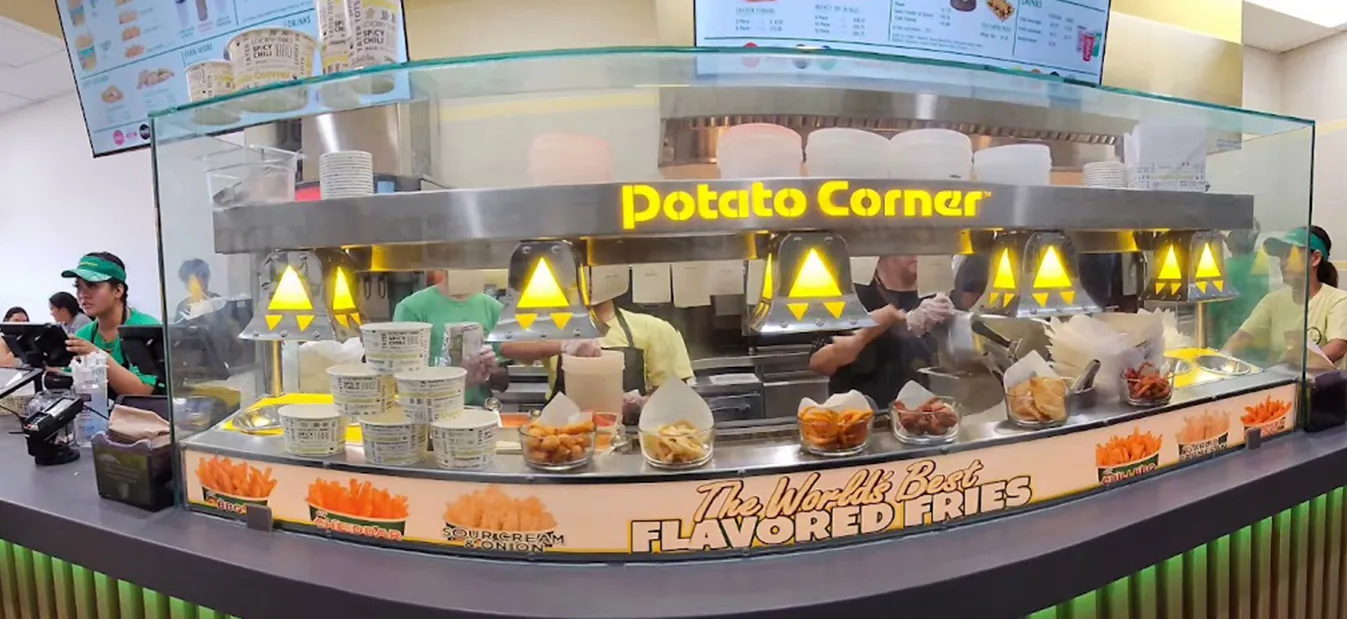
At a small kiosk set in a shopping mall corridor, freshly fried potatoes get a sprinkle of the customer's choice of flavored powder and are finished with a vigorous shake in their container. With this simple product and kiosk-style stores, Philippine-born fries specialist Potato Corner has grown into a brand with more than 2,500 stores in the Philippines and abroad. This piece follows the marketing and franchise strategy that took a kiosk started by four young people around the world.
1. A first day that sold six times the forecast
Potato Corner's first store was a kiosk that opened on October 16, 1992, at SM Megamall in Metro Manila. Its founders were four people including Jose Magsaysay Jr., who pooled their money to start the business with a total of about 140,000 to 150,000 pesos. They expected to sell 50 servings on the first day but sold 300, and the founders say they paid back their loans within 30 days. Magsaysay had worked at the burger chain Wendy's for nine years, from dishwasher to area manager.
2. The 'shake' performance and the fun of sizes
Potato Corner's product is flavored fries. Powders in flavors such as cheese, barbecue, sour cream and chili barbecue are sprinkled on freshly fried potatoes and shaken in its own way. That shaking motion itself is a performance that catches the eye at the counter.
Its range of sizes is also distinctive, scaling up from regular, large, jumbo and mega to giga and tera, plus “mix” options that combine several flavors. The fun of sharing a big size with family and friends extends the product's appeal. Magsaysay said in 2017 that if you want a brand to stick, you should market to children.
3. A franchise you can start with little capital
Potato Corner began franchising in 1993. Kiosks do not need a large kitchen and can open in small spaces wherever people gather, such as malls, schools, hospitals and bus terminals. In the Philippines, the franchise fee is 325,000 to 475,000 pesos (for a five-year term) with no royalties. Being able to start with little capital encouraged individuals and small businesses to join.
Growth was not always smooth. The 120 kiosks it had in 1997 fell to 40 by 2000 in the wake of the Asian financial crisis. It rebuilt from there, reaching 500 stores in 2015 and 1,000 in 2017. In December 2021, Shakey's Pizza Asia Ventures (SPAVI), operator of the Shakey's pizza chain, acquired the business and accelerated its growth.
4. Into 16 markets worldwide
In December 2022, it opened its first stores in London and Dubai, marking its 1,400th store. It reached its 2,000th store in Cebu in September 2024, after opening 359 new stores in 2023 alone. As of the end of 2025, it had more than 2,100 stores in the Philippines (about 80% of them franchised) and 470 stores in 16 overseas markets.
Overseas, it has spread to places including the United States, Canada, China and Taiwan. At its first Taiwan store, opened in August 2025, it sold a “Giant Potato,” three times its usual largest size, for 398 Taiwan dollars to mark the first anniversary in August 2026. In March 2026 it won “Multi-Site Restaurant of the Year” at an Asian restaurant industry awards program.
5. Building lines through social media
In recent years it has also put effort into creating buzz on social media. In July 2025 it teamed up with popular creator Niana Guerrero on a TikTok dance challenge offering a year's supply of fries. In Singapore in July 2026, it ran a promotion letting customers fill containers they brought with as many fries as they could fit for 8.80 Singapore dollars, which earned 25 million impressions on TikTok. At some stores transactions rose to about three times the usual level, with lines of more than two hours.
In December 2025, however, posts spread on social media claiming that headquarters had opened a company-owned store at a site proposed by a prospective franchisee, and the company began an internal investigation. Trust with franchisees is an essential foundation for a brand that grows through franchising.
6. What it means for Japanese companies
Potato Corner shows that designing products and stores that are small, easy to understand and fun to watch is a condition for spreading quickly in emerging markets. For Japanese restaurant brands considering franchising in the Philippines, offering formats that can start as mall kiosks or small stores, rather than insisting on large outlets, makes it easier to speed up openings and widen the pool of franchisees.