
Walk into almost any Filipino home and you are likely to find Lucky Me!. Monde Nissin's instant noodle brand is bought by about 99% of households, and its Lucky Me! Pancit Canton is often described as a national comfort food. Using public information, this piece examines the marketing that made a packet of noodles part of everyday Filipino life.
A note for Japanese readers: Monde Nissin is a Philippine company and is not affiliated with Japan's Nissin Foods.
1. Creating the dry noodle category
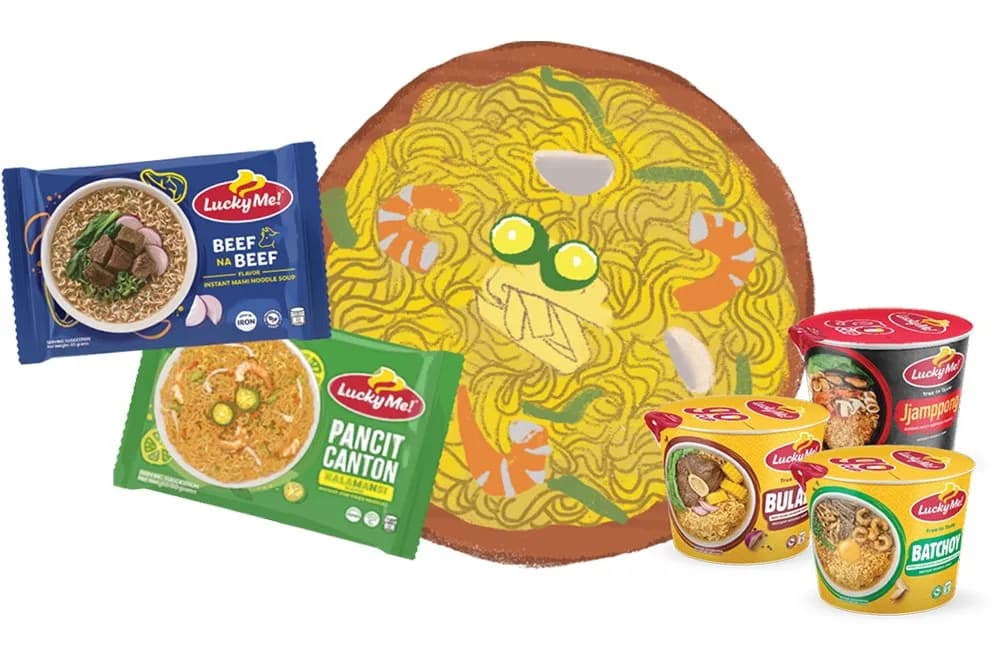
Monde Nissin was founded in 1979 as a biscuit maker. It launched Lucky Me! in 1989 with Instant Mami soup noodles, and in 1991 it introduced Lucky Me! Pancit Canton, a soup-less stir-fried noodle modeled on the Filipino party dish pancit canton. That product pioneered the dry instant noodle category in the Philippines. Flavors such as Kalamansi, using the local citrus, and Chilimansi followed.
The brand dominates its market. In the first half of 2025, CEO Henry Soesanto said "noodles experienced market share growth of 160 basis points to 69%," and its share of the dry pouch segment, where Pancit Canton competes, stood at 81.7%. The total noodle category is worth more than 50 billion pesos.
2. Ten years as the most chosen brand
In Kantar's Brand Footprint ranking, which measures how often households buy a brand, Lucky Me! has been the Philippines' most chosen fast-moving consumer goods brand for 10 consecutive years. In the 2024 edition, it reached 98.7% of households. It was also named the brand of the decade for 2012 to 2021, with households buying it about 31 times a year. In Kantar's first Philippine ranking in 2013, it had placed second behind Nescafé.
Low price points support that frequency. Instant Mami sells for about 8.75 pesos a pack. "At PHP 8.75 a pack, it offers great value to feed a family, and when you share it it's even greater value," CFO Jesse Teo said. In 2022, the brand added Kasalo, a larger value pack, to win back shoppers who were moving to a competitor's bigger packs. By June 2025, the company said Kasalo had overtaken that competitor.
3. Selling family mealtime, not just noodles
Lucky Me!'s brand message centers on family. In October 2007, it launched the "Kainang Pamilya Mahalaga" (Family Mealtime Matters) advocacy, encouraging families to eat together. In 2012, President Benigno Aquino III declared the fourth Monday of September as Kainang Pamilya Mahalaga Day, making a brand campaign part of the national calendar.
Its emotional TV commercials support the theme. A 2019 spot by Publicis JimenezBasic Manila used the APO Hiking Society song "Panalangin." "It is a spot that celebrates what familial love can do," said marketing director Melissa Pabustan at the time.
4. Listening to fans and joining pop culture
Lucky Me! also plays with its pop-culture status. In 2021, after consumers complained about changes to the product, it relaunched Pancit Canton with its original thin noodles in a campaign called "Pinakahinihintay Nathin" (What We've Been Waiting For). The campaign featured YouTuber Mimiyuuuh and reached more than 9.5 million people.
In October 2025, it partnered with Filipino pun T-shirt brand Linya-Linya for National Noodle Day, releasing items such as a "Pancituationship" shirt. International attention helps too: in 2025, The New York Times' Wirecutter picked Lucky Me! Pancit Canton Kalamansi as one of the best instant noodles.
5. The new challenge: premium imports
The brand now faces pressure from imported premium noodles, especially Korean brands. Monde Nissin estimates the retail premium segment at 4 to 4.5 billion pesos. Its answer is Lucky Me! Stir-Fried Jjamppong, a Korean-style Pancit Canton launched in selected chains in the first quarter of 2026. "We are planning more entries so that we can have our fair share on this growing subcategory," Teo said. The company also plans to keep "communicating recipes and pairing ideas to increase usage."
6. What it means for Japanese companies
Lucky Me! shows how a local twist on a familiar dish, low price points and a long-term family message can make a brand part of daily life. For Japanese food brands entering the Philippines, the lessons are to localize flavor around dishes Filipinos already love, to offer pack sizes and prices that fit how families share food, and to treat premium positioning, as Korean brands have done, as a way to compete with a dominant local leader.